How septic tanks and treatment plants work
Never had to think about where your toilet goes? You're not alone. Here's how it all works, with simple diagrams, in about three minutes.
The short version
If your home isn't on the mains sewer, everything from your toilets, sinks and showers goes into a tank in your garden. That tank does one of two jobs:
- A septic tank lets the solids settle out, then sends the still-dirty liquid into the ground, where the soil cleans it.
- A sewage treatment plant cleans the liquid itself, using air and natural bacteria, so much cleaner water comes out.
The difference matters because of where the water is allowed to go. That's what decides whether your system meets the rules.
How a septic tank works
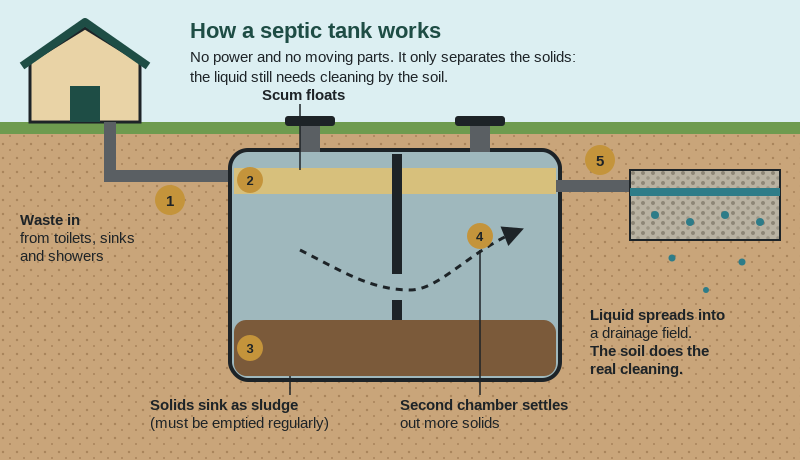
- Waste flows in from the house through an underground pipe.
- Fats and oils float to the top as a crust called scum.
- Solids sink to the bottom as sludge. This builds up and has to be pumped out by a tanker, usually at least once a year.
- A second chamber lets more solids settle.
- The liquid (called effluent) flows out into a drainage field: perforated pipes in gravel trenches, where the soil filters and cleans it.
Because the liquid is still dirty, a septic tank must not discharge straight to a stream, river or ditch in England. That's the rule that catches out so many older homes.
How a sewage treatment plant works
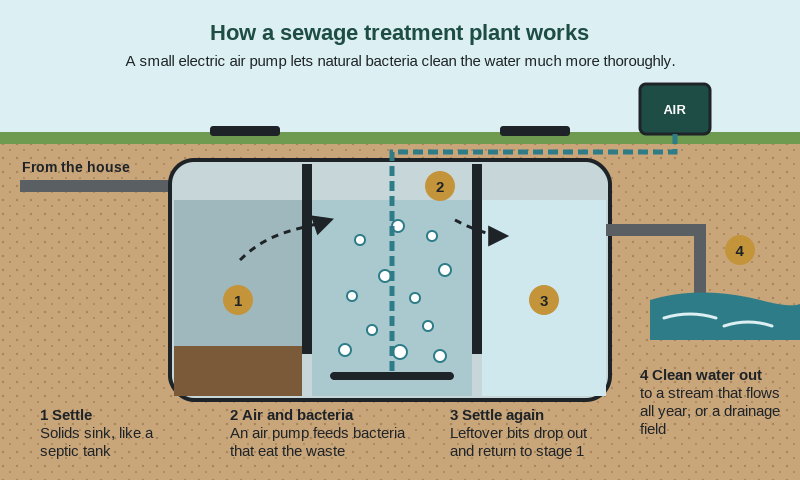
- Settle: like a septic tank, solids sink to the bottom of the first chamber.
- Air and bacteria: a small electric air pump bubbles air through the liquid. Natural bacteria thrive on it and break down the waste. This is the clever bit.
- Settle again: any remaining bits settle out and are returned to the start.
- Clean water out: the treated water is clean enough to go to a stream that flows all year round, or into a drainage field.
Most plants need electricity, and all need a yearly service and regular emptying. In return, you get far cleaner water and more choice about where it can go. See treatment plant installation.
Septic tank or treatment plant: pros and cons
Septic tank
Separates the solids. The soil does the cleaning.
- No electricity needed
- No moving parts to break
- Cheaper to buy
- Fine if your ground drains well
- Must not go to a stream, river or ditch
- Needs a drainage field and enough garden
- Struggles on heavy clay or wet ground
- Many old ones are cracked or too small
Sewage treatment plant
Cleans the water itself, with air and natural bacteria.
- Much cleaner water out
- Can go to a stream that flows all year
- Works where the ground drains badly
- Often needs less garden than a large drainage field
- Most need electricity for an air pump
- Needs a yearly service
- Costs more to buy
Neither is "better" for everyone. If your ground drains well and there's room for a drainage field, a septic tank can still be a good, legal option. If your only outlet is a stream, or your ground is heavy clay, a treatment plant is usually the answer. More detail: septic tank vs treatment plant.
Why so many septic tanks need replacing
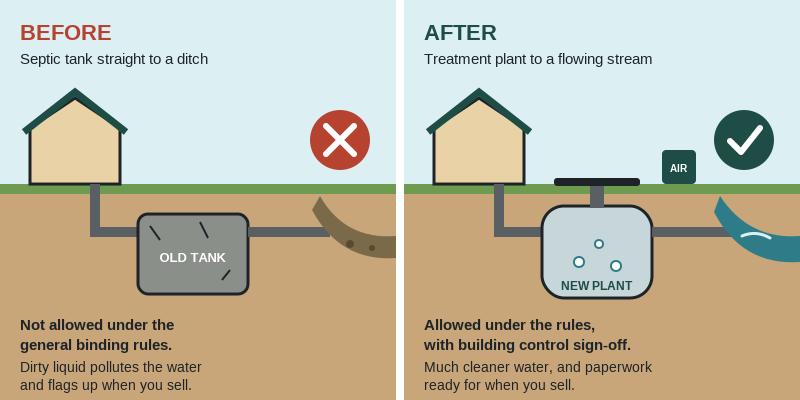
Many homes built before modern rules had septic tanks piped straight to the nearest ditch or stream. Under the general binding rules this isn't allowed, and the old deadline of 1 January 2020 has passed. Replacing the tank with a treatment plant often means the same outlet can be used, because the water leaving it is now clean, provided the stream flows all year. See septic tank replacement.
What a drainage field looks like
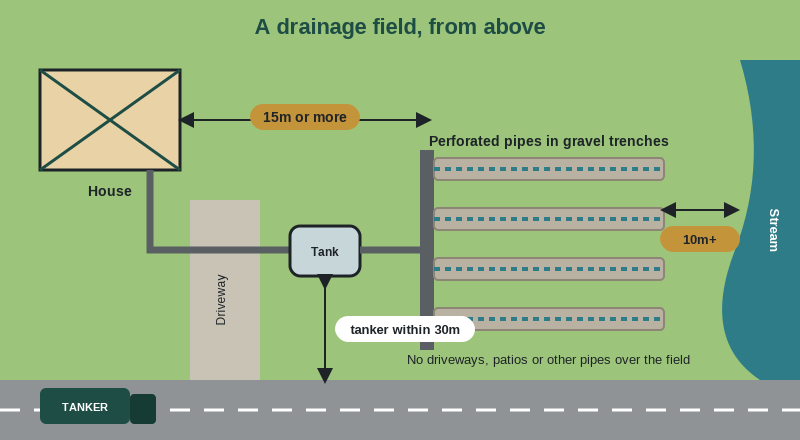
If the water is going into the ground, it needs a properly designed drainage field, not just a rubble-filled hole. The field must be at least 15m from any building and 10m from any watercourse, and the ground must pass a percolation test.
What a replacement involves
- Step 1Free site visitWe find your tank and where it drains, look at the ground and access, and answer your questions. No obligation.
- Step 2Fixed written quoteEverything in writing: the plant, where it goes, the electrics, putting the garden back, building control. No surprises.
- Step 3Building controlWe prepare the drawings and handle the building regulations application for you.
- Step 4InstallationThe old tank is emptied and removed or filled, and the new system goes in. A typical house takes about 3 to 5 days on site.
- Step 5Power and testingA registered electrician connects the plant. We start it up and check it is working properly.
- Step 6Handover packWe tidy up and give you a pack: what was fitted, where it is and how to look after it. Keep it for when you sell.
Is your septic tank compliant?
Answer four quick questions for a plain-English answer. Nothing is sent anywhere.
Common questions
How do I know if I have a septic tank or a treatment plant?
Most treatment plants need electricity, so there is usually a small air pump in a box or kiosk nearby, and you may hear a gentle hum. A septic tank has no power and no moving parts. Old septic tanks are often brick or concrete with heavy lids.
Where does my toilet waste actually go?
Into the tank in your garden. Solids stay in the tank until it is emptied by a tanker. The liquid flows out, either into the ground through a drainage field, or, for a treatment plant, sometimes into a stream.
Do treatment plants smell?
A working, serviced plant should not smell beyond a faint earthy odour when the lid is open. A strong smell usually means the air pump has failed or it needs emptying.
How long do they last?
The tank itself is built to last many years. Moving parts such as air pumps wear out and are replaced from time to time, which is part of why a yearly service matters.
Want us to take a look?
Free site visit across Yeovil and an hour around. We tell you straight what you need, what it costs and how long it takes.