Septic tank replacement
We take out old, failing or non-compliant septic tanks and put in a modern sewage treatment plant or a new drainage field. One local team, from the first survey to building control sign-off.
- Typical cost
- £7,000 to £15,000 for a normal house
- Time on site
- Usually 3 to 5 working days
- Paperwork
- Building control, design notes, maintenance pack
- Area
- Yeovil and about an hour around
When does a septic tank need replacing?
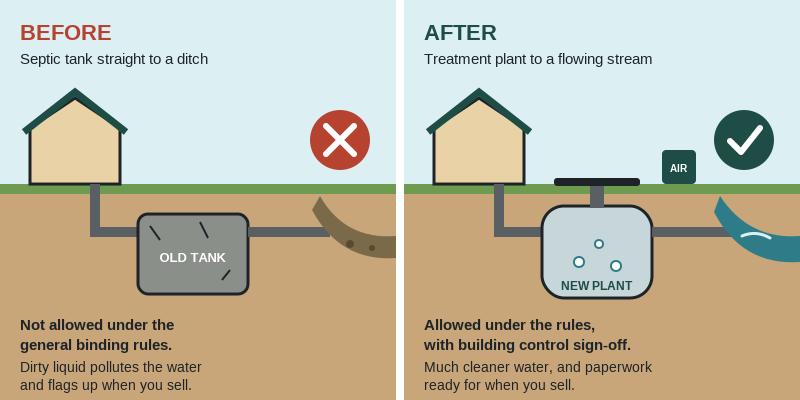
There are three common reasons, and they often overlap.
- It goes to a stream, river or ditch. Under the Environment Agency's general binding rules, a septic tank must not discharge straight to a watercourse. If yours does, GOV.UK says you must replace or upgrade it as soon as possible, with plans in place, usually within 12 months.
- You are selling or buying. The buyer's survey or solicitor will ask where the tank discharges. If it is not compliant, the buyer and seller need to agree who will put it right, as a condition of sale.
- It has failed. Cracks, leaks, smells, sewage backing up, boggy ground over the soakaway, or a tank that fills far too fast.
Not sure which applies to you? Read signs your septic tank is failing or the general binding rules in plain English.
Your options
GOV.UK gives three ways to sort out a septic tank that discharges to a watercourse. We look at all three on the first visit and tell you which one makes sense.
- Connect to the mains sewer. If a public sewer is close and it is reasonable to connect, this is usually the first choice. We will tell you if this is the case rather than sell you a plant you don't need.
- Replace the tank with a sewage treatment plant. A treatment plant cleans the waste water much more thoroughly than a septic tank, so it can discharge to a flowing watercourse under the rules. This is the most common fix, especially where the ground drains poorly. See sewage treatment plant installation.
- Keep a septic tank and add a drainage field. If the ground drains well, a septic tank can discharge to a properly designed drainage field instead of the stream. This needs a percolation test and enough space. See drainage field installation.
How a replacement works
Here is what happens from your first call to the day we hand over. You deal with one team throughout.
What happens, step by step
- Step 1Free site visitWe find your tank and where it drains, look at the ground and access, and answer your questions. No obligation.
- Step 2Fixed written quoteEverything in writing: the plant, where it goes, the electrics, putting the garden back, building control. No surprises.
- Step 3Building controlWe prepare the drawings and handle the building regulations application for you.
- Step 4InstallationThe old tank is emptied and removed or filled, and the new system goes in. A typical house takes about 3 to 5 days on site.
- Step 5Power and testingA registered electrician connects the plant. We start it up and check it is working properly.
- Step 6Handover packWe tidy up and give you a pack: what was fitted, where it is and how to look after it. Keep it for when you sell.
The detail, for those who want it
- Free site visit. We find the tank, the outfall and the pipe runs, ask how many bedrooms and people, and look at access for a digger.
- Survey and tests. Where a drainage field is an option, we dig trial holes and run a percolation test to Approved Document H. We check the sewer distance and any protected sites nearby.
- Fixed written quote. Plant size and make, where it goes, where the clean water goes, the electrics, reinstatement, building control. No vague "provisional sums" for the main work.
- Building control. A new treatment plant or septic tank needs building regulations approval. We prepare the drawings and submit the application with you.
- Install. The old tank is emptied by a registered waste carrier, then removed or filled. The new plant goes in, pipes are connected, power is run, and the ground is backfilled.
- Commission and hand over. We start the plant, test it, fix the maintenance notice inside your home, and give you a pack: what was fitted, where everything is, how to look after it. You need this when you sell.
What it costs
For a normal three or four bedroom house, a full septic tank to treatment plant replacement typically costs £7,000 to £15,000. The biggest things that change the price are the size of plant, where the treated water goes, and the ground. See the full septic tank replacement cost guide.
Why people around Yeovil choose a local firm
- We know the ground here, from the clays of the Levels to the stony ground towards Dorset, and what it means for drainage fields.
- We know the councils, building control teams and the Somerset phosphate schemes. If a funded upgrade might suit you better, we will say so. See phosphate credits in Somerset.
- One firm does the survey, design, digging, electrics coordination and paperwork. You are not left to chase three trades.
Common questions
Is it illegal to have a septic tank?
No. Septic tanks are still allowed in England if they meet the general binding rules, which means discharging to ground through a proper drainage field, not to a stream, river or ditch.
Do I have to replace my septic tank when I sell my house?
If it discharges to a watercourse, it is already non-compliant and must be upgraded. GOV.UK says the buyer and seller should agree who will do the work, as a condition of sale. It does not have to be the seller, but it does have to be agreed.
How long does a replacement take?
Most domestic jobs take 3 to 5 working days on site. Building control approval and booking add time before that, so allow a few weeks from first visit to finish.
Will my garden be dug up?
Part of it, yes. We plan the route to keep disruption down, protect lawns and drives where we can, and reinstate the ground when we finish. Your quote says exactly what reinstatement is included.
Do I need planning permission?
Building regulations approval is always needed for a new septic tank or treatment plant. Planning permission is sometimes needed too. We check this for your property during the survey.
Get a fixed, written quote
Free site visit across Yeovil and an hour around. We tell you straight what you need, what it costs and how long it takes.