The general binding rules, in plain English
If you have a septic tank or small sewage treatment plant in England, the general binding rules are the conditions you must meet to avoid needing an environmental permit. Here is what they mean for you.
What they are
The general binding rules are set by the Environment Agency under the Environmental Permitting Regulations 2016. The current version took effect on 2 October 2023. If your system meets them, you do not need a permit. They only cover domestic-type sewage.
The headline rules
- Septic tanks must not discharge to a watercourse. They must go to ground through a drainage field.
- Treatment plants may discharge to a watercourse that flows all year, or to a drainage field.
- Volume limits: up to 2,000 litres a day to ground, or 5,000 litres a day to surface water. A normal house is well under these.
- Standards: treatment plants must meet BS EN 12566, drainage fields BS 6297:2007 (for systems installed after the standards came in).
- Size: new systems must be sized to British Water's Flows and Loads guidance.
- Maintenance: maintain it as the maker says, and get it emptied before it is full, at least yearly or as the maker says, by a registered waste carrier.
- Selling: you must tell the buyer in writing about the system, where it is, any changes, how to maintain it and any records.
Is your septic tank compliant?
Answer four quick questions for a plain-English answer. Nothing is sent anywhere.
If your septic tank goes to a stream or ditch
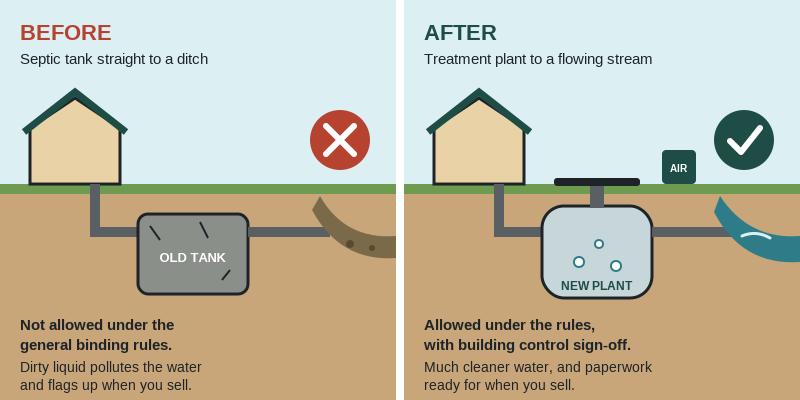
This has not been allowed since the rules changed, and the old deadline of 1 January 2020 has passed. You need to either connect to the mains sewer, replace the tank with a treatment plant, or install a drainage field. GOV.UK says to do it as soon as possible, with plans in place within a reasonable time, usually 12 months.
When you cannot use the rules
For discharges that started on or after 1 January 2015, you cannot rely on the general binding rules (and need to connect to the sewer or get a permit) if, for example:
- a public foul sewer is within 30m of your property boundary
- a surface water discharge is in or within 500m of certain protected sites (such as an SSSI, SAC, SPA or Ramsar site), or a ground discharge is in or within 50m of one
- a ground discharge is in a groundwater Source Protection Zone 1, which includes anywhere within 50m of a private drinking water supply
- a surface water discharge is to a dry ditch, an enclosed pond or lake
You can check protected sites on Defra's Magic map.
Existing or new discharge?
A discharge counts as new if it started, changed type, moved more than 10m, or increased past the volume limits on or after 2 October 2023. Replacing a septic tank with a treatment plant can make it a new discharge, so the rules for new discharges must be checked.
Where to read the rules yourself
- GOV.UK: discharges to surface water
- GOV.UK: discharges to the ground
- GOV.UK: septic tanks and treatment plants, what you need to do
These rules apply in England. Wales and Scotland have their own.
Common questions
Do I need to register my septic tank?
Not in England, if it meets the general binding rules. Registration was dropped when the rules came in. Wales and Scotland are different.
What happens if I ignore the rules?
The Environment Agency can take action if a system causes pollution or does not meet the rules. The bigger practical problem for most people is a sale falling through or being delayed.
Checked against GOV.UK guidance: 24 November 2026. Rules apply to England.
Get a fixed, written quote
Free site visit across Yeovil and an hour around. We tell you straight what you need, what it costs and how long it takes.